The Ocular Microbiome: A New and Exciting Frontier in Ophthalmology.
Emerging scientific evidence continues to highlight the important role of the ocular microbiome in maintaining eye health, opening new perspectives for innovative approaches to ocular surface care.
A recently published international review, "An Update and Overview of the Ocular and Extraocular Microbiome and Its Impact on Ophthalmic Care" (Advances in Therapy, 2026), includes references to Lactobacillus sakei—the key functional ingredient of OptoFresh® Probio Relief by InterMed—further reinforcing scientific interest in the role of the microbiome in supporting ocular surface health.
Understanding the Ocular Microbiome
Research into the human microbiome represents one of the most significant advances in modern biomedical science. Increasing attention is now being directed toward the ocular microbiome—a dynamic microbial ecosystem that contributes to ocular surface homeostasis, protects against pathogenic microorganisms, and helps regulate local immune responses.
A Comprehensive International Scientific Review
The publication in Advances in Therapy represents one of the most comprehensive reviews to date examining both the ocular and gut microbiomes and their relationship with ophthalmic diseases.
Contribution of Greek Scientists
The review was co-authored by researchers from the University of Ioannina and Aristotle University of Thessaloniki, highlighting the growing contribution of the Greek scientific community to this rapidly evolving field. In parallel, the University of Ioannina is currently conducting Greece's first doctoral research project dedicated to the ocular microbiome, reinforcing its pioneering role in this area of investigation.
The Gut–Eye Axis: An Emerging Area of Research
Recent studies suggest that dysbiosis affecting either the ocular or gut microbiome may be associated with several ophthalmic conditions, including:
- Dry eye disease
- Uveitis
- Glaucoma
- Age-related macular degeneration
- Diabetic retinopathy
At the same time, the gut–eye axis has become an important focus of research, with growing evidence indicating that gut microbial balance may influence mechanisms involved in ocular health.
Scientific Evidence on Lactobacillus sakei
Particular interest is given to Lactobacillus sakei, which has been investigated in an in vitro study for its potential to support normal ocular surface function by reducing pro-inflammatory cytokines while enhancing the antioxidant defense mechanisms of conjunctival cells.
The review also discusses the emerging role of paraprobiotics as a safer and more stable alternative to live probiotics for ophthalmic applications.
OptoFresh® Probio Relief
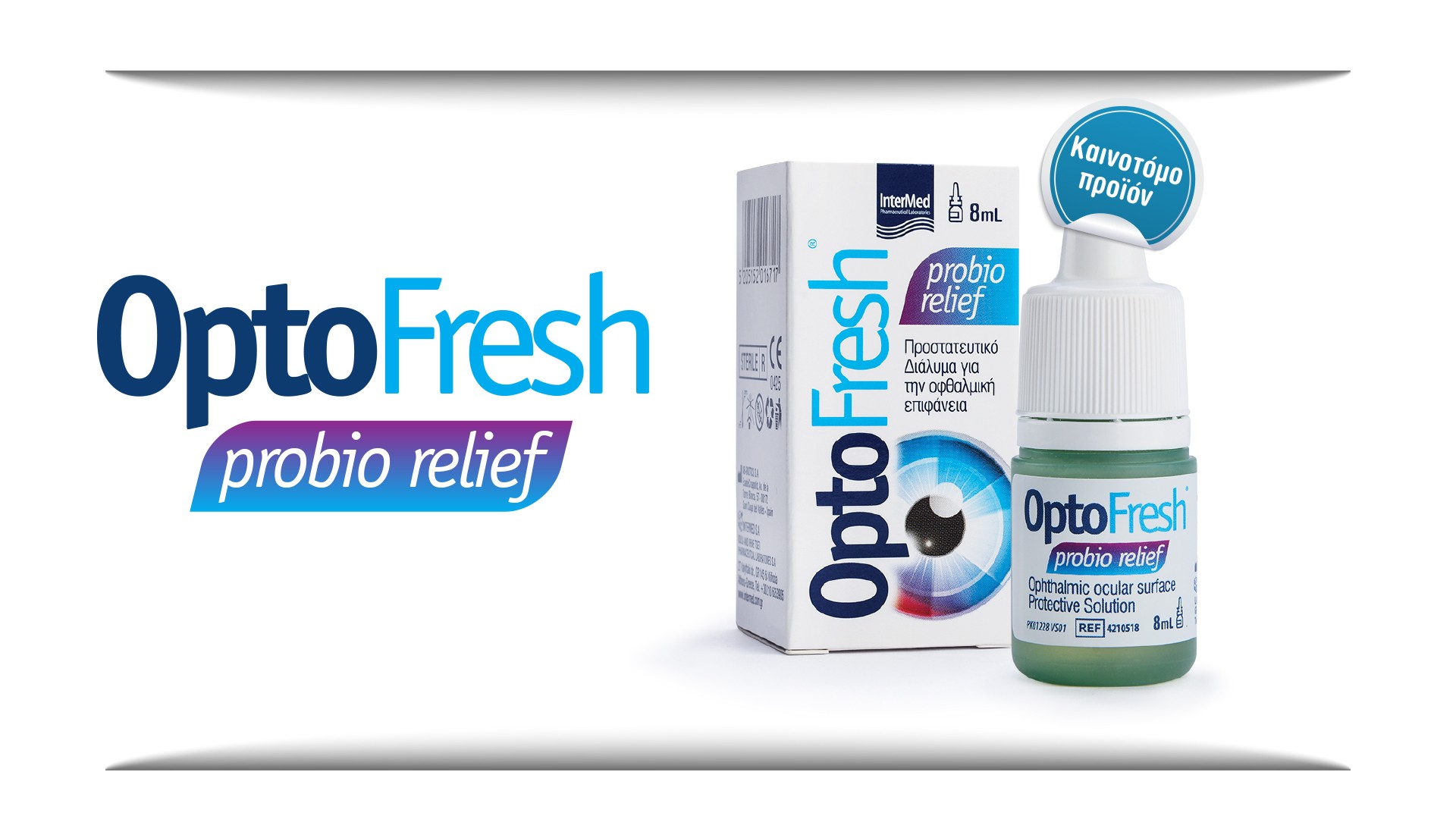
Lactobacillus sakei is the key functional ingredient of OptoFresh® Probio Relief, InterMed's innovative ophthalmic solution. The formulation combines a phospholipid blend derived from bacterial lysate of Lactobacillus sakei with hydroxypropyl methylcellulose (HPMC).
The product is designed to provide lubrication and hydration while supporting the physiological microbial balance of the ocular surface. By helping stabilize and restore the tear film, it contributes to ocular surface protection in cases associated with environmental microbial exposure, dry eye, conjunctivitis, blepharitis, blepharoconjunctivitis, chalazion, and during the perioperative management of ocular surgery.*
In recognition of its innovation, OptoFresh® Probio Relief was named "Product of the Year 2026" in the ophthalmic solution category following an independent consumer survey involving 3,200 participants in Greece.
Looking Ahead
The growing body of scientific evidence surrounding the ocular microbiome underscores its increasing clinical relevance and its potential to reshape future approaches to the prevention and management of ocular diseases.
Although research in this field continues to evolve rapidly, there is broad scientific consensus that the ocular microbiome will become one of the most promising and exciting areas of modern ophthalmology in the years ahead.